
Author: Envision Eyecare

TOP reasons to buy your next pair of glasses with Envision Eyecare

[av_textblock size=” font_color=” color=”]
TOP REASONS TO BUY YOUR NEXT PAIR OF GLASSES WITH ENVISION EYECARE!

  • QUALITY- Unlike items purchased throughout the year, it can be difficult for you to judge quality in a pair of glasses. That’s why it’s important to purchase your eye wear through a doctor’s office you can trust. At Envision Eye Care, we use only the finest materials, so your glasses will be dependable and attractive long after they’ve been purchased. We also work with one of the finest, state-of-the-art optical labs in the nation. We have chosen to partner with this lab to custom craft your eye wear because of their quality workmanship and our access to the very best advancements in lens designs.
  • SELECTION- Regardless of your budget or insurance allowance, everyone deserves to look fabulous! That’s why our optical boutiques offer a wide range of eye wear options and styles at various price points – from exclusive, high-end designer frames to fashionable values for the entire family.
  • VALUE PROMISE- We promise to provide you the best value – quality eye wear at a fair price. We do not carry cheaply made frames that easily break, outdated designer styles, and inferior lens products that can distort vision so we can offer you a cheap price. Nor do we advertise low prices so we can “up sell” you once you arrive at our optical boutique. Our fees reflect the quality of our workmanship – and when comparing glasses of similar quality – are often lower than many “one-hour” stores and  (online) optical chains.
  • TEAM OF EXPERTS- Our knowledgeable and courteous optical team will expertly help you select the frame and lens package that’s right for your lifestyle and budget, and support you to understand your lens options, frame materials, warranties, etc. We want to ensure you are completely happy with your new pair of glasses.
  • SATISFACTION GUARANTEE- When you purchase a pair of frames and lenses from the optical boutique at Envision Eyecare, you have our commitment to your satisfaction. We guarantee our workmanship and the accuracy of your prescription lenses, and offer free adjustments, minor repairs, and cleanings for the life of your eye wear.

What 30,000 Consumer Reports’- survey respondents had to say. A recent Consumer Reports study confirms independent eye care practices score higher for quality, frame selection, care taken to fit glasses, staff expertise, and follow-up service.

“ … you might do better getting your specs at a doctor’s office or independent optical boutique; those typically scored high marks across the board, particularly when it came to employee know-how, service, and the quality of the finished glasses. You might even spend less than you would at some high-profile chains.” Consumer Reports, December 2010

THANK YOU FOR SUPPORTING LOCAL BUSINESS!
[/av_textblock]

Headed Back to School

Four Reasons Why Your Child Should Have an Eye Exam

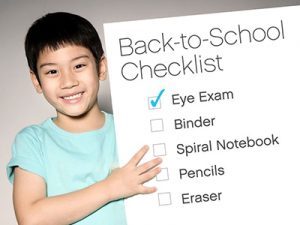
A vision screening at school, church or even a pediatrician is not a substitute for a comprehensive eye exam. Serious eye health and vision concerns can be missed at a screening, certain states are mandating children have a comprehensive exam before entering school. The doctors at Envision Eyecare advise yearly eye health exams for children for the following important reasons:

  1. 80% of learning occurs through the visual system, and in order for your child to reach his/her full potential in school, it is critical that eye tracking, acuity, and focusing are functioning properly. 
  2. Most ultraviolet radiation damage to the eyes occurs in the first 2 decades of life, so it’s important your child’s eyes are protected with the sunglasses that protect against Ultraviolet and Blue light filters.
  3. Long term exposure to blue light emitted from the sun and digital devices is harmful to the eye. This may also affect sleep patterns and cause eyestrain.
  4. Vision screenings only test eye sight, not eye health, and it’s important your child’s eye health is evaluated as well.  

Unfortunately, studies show that only 31% of children, ages 6-16 have an annual eye exam, and 70% of children under the age of 6 have never had an eye exam.

As a result, 1 in 4 children will go back to school this year with an undiagnosed vision problem that could interfere with learning.

The following is a true story about a pediatric patient who would have passed a vision screening: Dr. Bryant examined a child with no complaints and 20/20 vision. The child had swollen optic nerves indicating a potential brain tumor. Fortunately, the child was quickly diagnosed and underwent urgent surgical intervention to save his life. This is an extreme example, and rare, however it illustrates why a comprehensive eye health exam is so important for all children.

!URGENT! Recall on solar eclipse glasses!

URGENT RECALL OF SOLAR GLASSES!

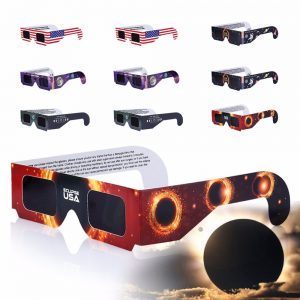
We are sorry to inform you that due to new information provided by Amazon the eclipse viewing glasses we purchased may not be certified for viewing the eclipse. We were told these glasses were certified but over the weekend we were informed the certification may not be legitimate. We ask that you do not use these eclipse glasses, we can not guarantee that they will properly protect your eyes. We will gladly refund anyone who purchased these glasses through us. Below is the information provided by amazon:

“To protect your eyes when viewing the sun or an eclipse, NASA and the American Astronomical Society (AAS) advise you to use solar eclipse glasses or other solar filters from recommended manufacturers.  Viewing the sun or an eclipse using any other glasses or filters could result in loss of vision or permanent blindness.  

Amazon has not received confirmation from the supplier of your order that they sourced the item from a recommended manufacturer.  We recommend that you DO NOT use this product to view the sun or the eclipse.”

Our office is so sorry for this inconvenience. Located below is a list given to us from the American Astronomical Society as recommendations on where to get your approved eclipse glasses. Please enjoy the eclipse safely!

  Solar Viewer Brands

Why Do My Eyes Need to be Dilated?

Why Do My Eyes Need to be Dilated?


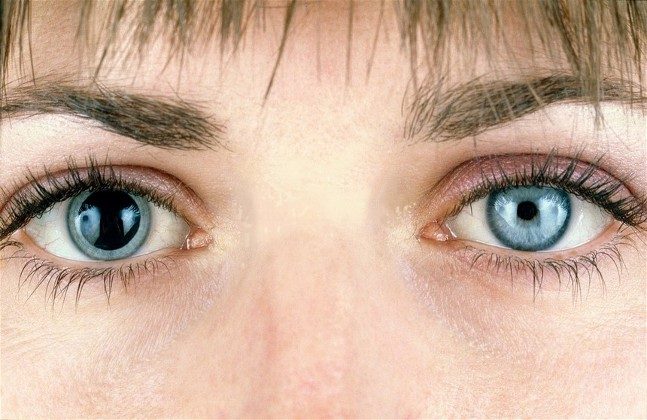
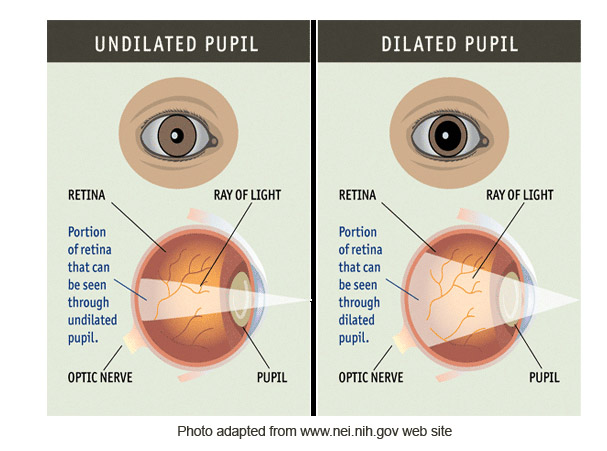
This is a common question that we hear from patients.  A simple explanation will explain the importance and reason this process is performed as part of a comprehensive eye health exam.  The inside of eye is lined with a delicate tissue called the retina.  The retina is a crucial component of the eye which allows light to be interpreted for central and peripheral vision.  In order to evaluate the retinal health, we have to look through the pupil, which is the dark spot or opening in the center of the eye.  Pupil sizes vary depending on a variety of factors. For example, two of the most common factors affecting pupil size are age (as age increases, pupil size decreases) and medications.


When light is shined in the eye, the iris, or colored part of the eye constricts, which decreases the pupil size. If one thinks of the pupil as the aperture of a camera, then the smaller the pupil (or aperture) the more limited the hole your eye doctor can look through. This translates to a smaller amount of retina we can evaluate.  Typically, we can evaluate about 40% of this tissue without dilation, depending on the natural pupil size of that individual.  Dilation is necessary to assess the peripheral retina for tears, thinning, holes, or other lesions that could potentially lead to vision loss.  


Once performed and the retina is determined to be healthy, dilation may not need to be repeated every year.  However, certain symptoms may develop which necessitate dilating the eyes in an urgent manner such as flashes of light, new floaters, or peripheral vision loss.  Diabetics should be dilated every year.


Different strength dilation medications and side effects are dependent on the size of the pupil and color of iris.  The side effects of dilation are: reduced focusing ability at near, and light sensitivity that typically lasts about 3-4 hours.


Our goal as your eye care provider is to ensure healthy eyes, lifelong.  Performing dilation allows for completion of your comprehensive exam at the time of your annual visit.  Indications and contraindications for dilation are determined on an individual patient basis.  

Related image

Innovations in Contact Lens Technology

Innovations in Contact Lens Technology


Contact lenses are medical devices that can improve vision, add convenience to activities, and bandage an injury to improve comfort and aid healing.  It is very important to have a contact lens evaluation to make sure your eyes are healthy enough to wear them comfortably without damaging the ocular surface, and to ensure the contact fits your eye properly.  There have been many advances in contact lens technology over the last decade to enhance comfort, breathability and vision demands.  We will discuss the different types and modalities of contact lens, wear time schedules, and the benefits of utilizing new technology to expand the demographic of eligible contact lens candidates.

The majority of contact lens wearers are in soft contact lenses.  These lenses are available in daily disposable, 2 week disposable, and 1 month
disposable wear schedule regimens.  Daily disposables are the healthiest option with improved convenience and comfort.  The cost difference is negligible when the consideration of solution cost is no longer needed with daily disposables.  Also, the packaging is recyclable, except the foil.

When the eye is not completely round and has an oval curvature, it is termed astigmatism.  In order to correct astigmatism with contacts, we must use a toric contact that is larger in diameter and must be orientated properly to provide adequate vision.  Different designs of toric lenses are available for different shapes of the eye to provide the best vision and comfort.   

Hard contacts are usually indicated for irregular corneal shapes and can be initially uncomfortable.  For those who find hard lenses unbearable, a blended(soft and hard) contact or scleral contact lens can be a valuable alternative to treat corneal diseases that cause irregularity.  

As we age, the ability to see up close slowly diminishes and a different modality of contact lenses are necessary.  Three main choices are multifocals, monovision and distance vision only with readers over the contacts as needed for near vision tasks.  Multifocals are the best option to try first because it provides seamless vision from distance to near, but is pupil size dependent so these do not work perfectly for everyone.  Monovision is when we fit the dominant eye for distance and the non-dominant eye for reading.  This seems like it would create imbalance or eye strain, but works very well for the majority of people who are not comfortable with multifocals.  These two modalities can be modified and used in combination dependent on patient visual demand.  If neither of these options is adequate, correcting the distance vision with the use of readers
over the contacts is a last resort.

Ortho-keratology is the science of using hard contacts during sleeping hours to gently change the curvature of the eye overnight, so no correction is needed during the day.  The initial comfort is sometimes an issue, but improves over time.  This has been implicated in reducing the progression of nearsightedness in the adolescence.   
Newer innovations in contacts have become exciting for other demographics as well.  A brand new lenses has been released specifically geared for the avid device user to reduce computer fatigue and enhance performance.  Also, bluetooth technology incorporated in the contact is on the horizon to monitor eye pressure and blood glucose, in order to better manage glaucoma and diabetes.

“Why are my glasses so expensive?!”

You may be asking yourself this question after seeing online and commercial advertising. Our objective at Envision Eyecare is to educate our patients on the difference in quality and craftsmanship between our glasses and those purchased online or through a commercial vendor.  It is through education that we can convey why all glasses are not created equal.  The Envision Eyecare team takes a great deal of pride in the services and products we offer as well as the information we provide to our community.  We are unique from other providers, so we hope you find this information helpful as you decide what’s important for your best sight and eye health.

First, why wouldn’t you purchase your eyewear online or from a commercial, corporate vendor if you could save on cost?  Research shows that over 50% of online eyeglasses are returned to the consumer with incorrect prescriptions and/or materials not delivered as ordered.  Plus important measurements that ensure your best vision are generated haphazardly, which can have detrimental effects on your best vision and comfort.  Most online and commercial vendors promote cheap prices which leads to a diminished sense of sight and performance. While the immediate benefit may be cost saving, you’ll often sacrificing your visual clarity, comfort, protection and, most importantly, preservation of your sight. As with other consumer purchases, the adage “you get what you pay for” certainly holds true with eyewear.

Read on to learn how our Optical Experts use their hard-earned skills and knowledge to craft the best eye wear possible for your lifestyle, fashion, fit and protection.

Top 5 things we consider when ordering your great spectacle lenses:
  1. Lens material- (plastic vs. polycarbonate)-polycarbonate is thinner/lighter and impact resistant for improved comfort, safety and aesthetics
  2. Premium anti-reflective treatments (or AR)- this treatment reduces glare and reduces fatigue with computer use; cheaper coatings typically peel or chip after a short time.
  3. Lens surfacing (Digital vs traditional)- digital surfacing enhances visual clarity by reducing peripheral distortion and improving range of vision in progressive lenses
  4. Blue light and Ultraviolet radiation filters- protect against macular degeneration, the #1 cause of blindness over 55, as well as Cataracts and eyelid skin cancer (which accounts for 8% of all skin cancers.)  Other benefits include improved sleep and reduced eye strain from devices.
  5. No-line bifocals/progressives (premium vs standard)- premium progressives provide a wider area for reading and intermediate vision with reduced peripheral distortion leading to easier adjustment and everyday use.

Top 3 things we consider when ordering your fabulous new frame:

  1. Your exact spectacle prescription- matching your Rx to a specific frame is a critical first step in making your glasses accurately.
  2. Frame Material- hand-selecting frames that are made from quality metals, such as titanium or are hand-made (see STATE OPTICAL CO.) make for a more durable frame over time. Cheaper frames are made from poorer quality metals and injection mold plastics which lose their adjustment and break easily.
  3. Comfort and Fit- Your face and fashion sense means a lot to you! Cheaper frames are heavier, leading to daily discomfort, and can be more difficult to adjust and hold their shape. Our patients feel more confident and attractive, leading to a superior user experience for the life of their eyewear.

We stand behind what our Doctor’s prescribe for you and are able to guarantee the quality of your eye wear if they are made in our office. We ensure quality control for all glasses orders, checking that they were made properly and that frame adjustments are accurate for you, making sure you have the best for your eyes.

The list above is a guide to educate you on products that will enhance and protect your vision. We believe your eyes and your vision are worth it and we hope you do too!

Our optical team is committed to excellence and quality.  We are here to partner with you to find best fit eyewear for the demands of your everyday life. We offer a wide range of products for all budgets, plus we want you to SEE and be SEEN wonderfully!


Age-Related Macular Degeneration

[av_textblock size=” font_color=” color=”]
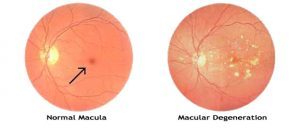
The macula is a small area in the eye responsible for our precious central vision, color perception and therefore, our independence.  It is a delicate tissue comprising only a few millimeters of the retinal lining that surrounds the inside of our eye.  Age-related Macular degeneration(AMD) is a medical condition affecting 8 million Americans, accounting for more than 50% of all vision loss in the US caucasian population.  This condition is constantly growing with our aging population and expanding life expectancies.  Important risk factors include family history, smoking, age, Ultra Violet exposure, diet, hypertension, and high cholesterol.  While genetics explain upwards of 60% of the risk, a complex interaction of unfavorable environmental and lifestyle events account the the remaining risk of progression.   Most common signs and symptoms are distorted or missing area of vision, shadows, slow recovery time, declining color perception, and contrast sensitivity.  
Treatment and management depend on the form and stage of the disease, but prevention and early detection are paramount.  Concisely, the dry form causes slow atrophy and scarring due to cellular debri accumulation, called drusen, and is divided into three progressive stages.  Duly noted, is a link to Alzheimers disease, due to the similarity of the drusen accumulation.  Retinal imaging is being explored as a future indicator of this disease.  Genetic testing of specific markers are strong predictors of risk/progression of these age related diseases, but can be an expensive option.  The goal is to promote prevention and reduce progression through lifestyle changes and supplementation of carotenoids, such as lutein and zeaxanthin with omega-3s.  Studies have shown that a combination of these supplements reduce the risk of progression(see AREDS 2 study). Cessation of smoking is imperative. UltraViolet Radiation protection when outdoors and protection from extended exposure to high-energy visible light emitted from digital devices, known as Blue Light, is also crucial. The wet form of macular degeneration is less common(10-20%), but has a rapid onset.  It usually preceded by the dry form, but not always.  It is caused by abnormal blood vessel growth that leak and require treatment immediately upon diagnosis, with early detection leading to more favorable outcomes.  The mainstay of treatment for wet AMD is monthly ocular injections to reduce leakage and prevent further blood vessel growth.  Although this procedure may seem extraordinarily undesirable, it is relatively painless and preserves sight for this aging demographic that would otherwise have lost their independence.  Previous treatments include lasers that scar the macula resulting in permanent vision loss, but halted new blood vessel growth.  

Several new treatment options are being explored for this disease.  The optimistic results of a topical maintenance drop daily instead of monthly injections are on the horizon.  Promising stem cell research results will dramatically change the future treatment.  Reducing risk factors is the paramount in those genetically predisposed.  At Envision Eyecare, we evaluate an indicator of risk on every patient over 40(or family risk of AMD and Diabetics), known as the Macular Pigment Optical Density(MPOD).  With dietary changes and/or supplementation, we have documented significant improvements in pigment density, which study indicate shield the macula from deleterious effects of high-energy blue light.  Being proactive can function as a barrier to those at risk.  Our team at Envision Eyecare is passionate about enhancing, protecting, and preserving our patients vision.  We provide education on technology that completely filters the blue light to protect the macula, also promoting less fatigue on digital devices and enhancing deep sleep patterns.  In later stages of AMD, low vision therapy specifically designed for patient needs, including devices such as magnifiers, specular telescopes, computer applications and closed-circuit TVs, can also be helpful in maintaining independence.

In the next edition, I will explore the holistic approach to ocular health and vision correction with an open mind, addressing the insightful benefits and gross misconceptions that concern me from an evidence based prospective.  Balance is essential. Knowledge is awareness.  Stay connected.  Protect your eyes and enjoy your sight!

All the best,

Dr. B
[/av_textblock]

[av_one_full first min_height=” vertical_alignment=” space=” custom_margin=” margin=’0px’ padding=’0px’ border=” border_color=” radius=’0px’ background_color=” src=” background_position=’top left’ background_repeat=’no-repeat’ animation=” mobile_display=”][/av_one_full]

[av_one_half first min_height=” vertical_alignment=” space=” custom_margin=” margin=’0px’ padding=’0px’ border=” border_color=” radius=’0px’ background_color=” src=” background_position=’top left’ background_repeat=’no-repeat’ animation=” mobile_display=”][/av_one_half]

[av_one_full first min_height=” vertical_alignment=” space=” custom_margin=” margin=’0px’ padding=’0px’ border=” border_color=” radius=’0px’ background_color=” src=” background_position=’top left’ background_repeat=’no-repeat’ animation=” mobile_display=”][/av_one_full]

vision problems in children

Vision Issues Can Affect Learning in Children

It’s estimated that up to 80 percent of learning occurs through a child’s eyes. But what happens when a preschooler or early grade school child has vision problems such as hyperopia, also known as farsightedness? If you are farsighted that means you can see far away, but you have trouble focusing on things that are up close. For a farsighted child in a classroom that means they have trouble focusing on close-up items, such as a book or computer screen. Learning to read and write is visual. Reading and writing skills are learned very early on in a child’s school years.

Do you know if your young child is farsighted? Do your young child’s teachers recognize if he or she is farsighted? Hyperopia is often undiagnosed without a proper eye exam by an optometrist. School exams may not catch hyperopia. If it was not known that your child had vision problems then it could certainly affect your child’s learning and development, in particular learning of reading and writing skills. The Boston Globe reports “even moderate uncorrected farsightedness in four- and five-year-old children significantly affects early literacy skills, according to” the findings of a 492-child study published in the journal Ophthalmology and supported by the National Eye Institute. The study’s findings indicate, “An untreated vision problem can delay a child’s grade school readiness, says lead author Marjean Kulp of Ohio State University’s College of Optometry.”

Hyperopia can not only affect your child’s academic success, it also can affect a child in the classroom in a more physical way by causing fatigue, tension, and discomfort. Learning can become difficult and stressful for a child. The inability to see well can create a short attention span in the classroom or when completing homework. Your child may even flat our refuse to do schoolwork due to frustration.

All of this frustration for your child can be avoided by a simple eye exam by an optometrist! Envision Eyecare can determine if your child is nearsighted or farsighted and either condition can be corrected. Regularly scheduled exams are important as a child’s vision can change throughout the years. The AOA recommends a child visit an optometrist every 2 years, unless of course there is a condition that allows for more frequent visits. Please discuss with your eye doctor and follow their recommendation.

Sun Safety for Your Eyes and Skin

Don’t get burned! July is National UV Safety Month and we’re here to educate you on sun safety! According to the American Academy of Dermatology, it’s estimated that 1 in 5 Americans will develop skin cancer in their lifetime. Harmful rays from the sun can also cause sunburn, damage to your eyesight, the appearance of aging, and other changes in your appearance. You can easily protect yourself and your family from the sun.

The simplest way to protect your skin is to wear protective clothing, a hat and broad-spectrum water-resistant sunscreen on any exposed skin. Broad-spectrum means it protects against both UVA and UVB rays. The sunscreen should have a Sun Protection Factor (SPF) of at least 30 and should be applied liberally. The rules for applying sunscreen is basically apply some and then apply some more because the AAD says most people only apply 25-50% of the recommended amount of sunscreen. That reduces the sun protection! Apply a generous amount 15 minutes before you go outdoors. It should be reapplied about every 2 hours and/or after swimming or sweating. Don’t forget lip protectant with SPF. Sunburn is not fun; remember that it increases your chances of skin cancer.

The best way to protect your eyes and the skin around them is also a hat and high-quality UV-resistant sunglasses. Sunglasses should cover and protect you from all angles. They should block 99-100% of UV rays and absorb most HEV rays. Babies and children need to be properly clothed and outfitted with sunglasses and hats. Who would want to miss an opportunity to dress your little one in cute sunnies and hats anyway?! We can help you pick out the best sunglasses to protect yourself and your loved ones.

Shade is nice, so why not try it out! Sitting in the shade can block rays. Sources say the sun is at its strongest between 10 am and 2 pm. That sounds like the perfect time to enjoy a shady spot! Keep in mind, just because it’s cloudy doesn’t mean you can skip the sunscreen! Up to 80% of the sun’s harmful UV rays can still penetrate your skin on cloudy days. Just because it’s winter doesn’t mean the sun isn’t a danger either. You should wear your sunglasses in the shade, on cloudy days, and all seasons. Other risks for sun exposure are higher altitudes and reflective surfaces such as water, sand or snow.

To read more about sun safety or determine your risk levels, you can check the Environmental Protection Agency’s UV index daily.

Free Eye Exam for Infants at Envision Eyecare

Envision Eyecare participates in a wonderful program called InfantSEE, a public health program that allows us to provide a comprehensive eye assessment to children between the ages of 6 and 12 months as a no-cost public service. This program is managed by Optometry Cares of the American Optometric Association Foundation. According to Optometry Cares, the program is “designed to ensure that eye and vision care becomes an essential part of infant wellness care to improve a child’s quality of life.”

It is extremely important to schedule an early eye exam for your baby’s health and development. Your child’s eyes are developing, his or her eyes and brain are learning to see, all of which is helping your child to learn and develop. Proper or improper eye development is not necessarily something that can be recognized by a parent. Your baby’s vision is huge in developing coordination and motor skills, recognition, stimulation, and so much more at such an early age. Learn more about how an infant learns to see and the steps of eye development. An optometrist can also help you determine how to visually stimulate your child and help his or her vision develop properly. According to the AOA, by two years of age, a child’s eye-hand coordination and depth perception should be well developed.

The other unfortunate fact is that many eye conditions have no symptoms that can be identified by a parent or even a routine check-up by a family physician. A more detailed exam by an optometrist can in fact catch these eye conditions that can be treated or corrected early on in your child’s life. With some conditions, your child’s vision can be corrected, in the worst case scenarios it can be saved. The hard facts according to the AOA are that of the 3 to 4 million babies born every year in the United State, 1 in 20,000 has retinoblastoma (eye cancer), 1 in 25 will develop strabismus (commonly known as crossed eyes), and 1 in 30 will develop amblyopia (or lazy eye).

At your infant’s first eye exam Envision Eyecare will test for excessive or unequal amounts of nearsightedness, farsightedness, or astigmatism. We will test for eye movement ability and eye health problems. These tests will not be invasive for your child. Don’t worry; our Envision Team is experienced with children of all ages. Helping ensure your child’s development and quality of life brings us great joy!

Schedule your infant’s comprehensive eye exam with us, compliments of InfantSEE!