Tag: eye care

Fall Eye Allergies

Fall in the mountains is beautiful! Red, itchy eyes are a pain…

We probably don’t have to tell you that if you have red, itchy, burning eyes, you may have seasonal allergies. It’s a very common eye issue. With the arrival of fall, this is the time of year that certain allergies kick in. You may not think about calling Envison for your allergies, but we can help you find relief!

Ragweed is a big contributor for the fall allergies. One of the ways to help reduce your allergies is avoiding the allergens. But how can you avoid pollen? You can wear glasses or sunglasses to help cut down on allergens entering your eyes, especially larger or wraparound styles that provide greater coverage. You can also switch to daily contact lenses. Daily contacts allow you to start with a fresh pair each day, rather than a pair that has collected allergens from previous wear. Envision can also supply you with preservative-free eye drops to help keep your eyes free and clear from allergens and cut down on irritation.

A Few Other Tips:

Avoid going outdoors when the pollen count is highest, typically around mid-morning and early evening. Weather alerts are available for this. Keep your windows closed in your home and vehicle to avoid allergens inside. Use a clean air conditioning system and avoid window fans. You can even purchase an air purifier to help cut down on allergens.

We know it’s hard, but do not rub your eyes when they itch! It just makes things worse. Rubbing releases more histamines from your cells while your body is already working to remove the foreign matter from your eyes, which results in even more irritation.

If you’re suffering from irritated eyes due to allergies, don’t delay! Schedule an appointment with us to find relief!

Procedures We Are Following To Keep YOU Safe!

 We are open for routine care! We have remained diligent in our safety procedures during the pandemic. Here are the top 7 safety measures we practice every day to keep you safe!

1. Masks, of course! We’re all wearing masks, and you are too!

2. Hand Sanitizer and Hand Washing: All team members are consistently sanitizing and washing hands, and we ask that you do the same when entering the office.

3. We’re crazy about sanitizing! All surfaces are sanitized after each patient and throughout the day.

4. Social distance please: We ask all patients to respect a 6ft social distance with other patients, at all times in the office. Orange markers are placed around the office to indicate 6ft between each person.

5. COVID-10 Health Screening Process: Before a patient enters the office, team members are asking a COVID-19 screening question during our check-in process. As patients enter, their temperature is taken to ensure everyone’s safety.

6. By Appointment Only: Only patients with appointments are allowed in the building to help maintain our safety measures.

7. Disinfecting Frames: We sanitize all frames that are tried on during a patient’s visit with our Optical Experts to purchase new glasses.

***

Your safety and wellness is our top priority, and hope all of our patients are staying happy, and healthy! Thank you for your continued support of our locally owned and operated business! Any service or purchase makes a difference in our community! 

 Image may contain: 8 people, screen

 Sincerely,

Dr. Larry Golson, OD and Dr. Eric Bryant, OD

&

Your Envision Eyecare Team

Practice UPDATES Beginning March 23rd, 2020

Hello again dear community,

We hope you’ve been staying well and as calm as can be during this heightened state of the COVID-19 pandemic.

Our leadership team has been on full alert as to how we can get back to life and business as usual as soon as possible, though it doesn’t look like that will be anytime soon. In the meantime, to ensure we keep purpose in our daily lives and tend to our patients’ needs, we’ve come up with the following availability for patient care and product services. This schedule will take us through the next 2 weeks (at minimum) in the safest ways we know how.

  • ALL previously scheduled appointments through Friday, April, 3rd have been CANCELED.

Hopefully, you’ve received a phone message from us about this if you were scheduled in the next 2 weeks. We have you on our recall list and will be rescheduling appointments as soon as the CDC deems it is safe to do so.

  • Beginning Monday, 03/23/2020 our office phones will be ON (see amended hours below), though our doors will be LOCKED. 

    • What we CAN do now:

      • Telemedicine for URGENT eye care, including new patients

      • In Office urgent eye care if telemedicine is deemed insufficient

      • Fulfill contact lens orders

      • URGENT eyeglass repair

      • Product curb-side dispense for glasses and contacts

      • Product curb-side delivery for dry eye and supplements

      • Medication prescription refill via phone

    • What we CAN NOT do now:

      • Routine eye care

      • Fit glasses

      • Eyeglass adjustments

      • CL follow-up appts/dispensing of trial lenses

***Please note that we are not admitting anyone into the building unless it has been approved by one of our doctors***

  • We will be accepting phone calls at (828) 254-6757 during the following times for the next TWO weeks, March 23rd- April 3rd 2020:

    • MONDAY 10:00 am- 4:00 pm

    • TUESDAY 10:00 am- 4:00 pm

    • WEDNESDAY: 12:00 pm-6:00 pm

    • THURSDAY 10:00 am- 4:00 pm

    • FRIDAY: 10:00 am- 4:00 pm

  • We will be triaging URGENT eye care needs via *Telemedicine.

We will put you in touch with Dr. Golson or Dr. Bryant to help resolve your urgent eye care needs as soon as possible. Instructions and information on this process are below.

*Instructions on Telemedicine:

Envision Eyecare is excited to offer access for urgent eye care needs with Telehealth service.

Telehealth is a virtual visit conducted with an Envision Eyecare Doctor, in most cases via video, imaging or a phone call from a safe location of your choice. Telehealth supports the advised social distancing that could help limit the spread of the COVID-19 virus.

What you can accomplish with a Telehealth appointment:

You can talk about symptoms, or, follow up on your prior medical or vision problems. In many cases, you can receive a diagnosis and medical, spectacle or contact lens prescription (as needed) for your health issues from the convenience of your safe location.

How to schedule a Telehealth appointment:

Please call (828) 254-6757 or email us at [email protected]  and request a Telehealth appointment and we will find a convenient time for you to schedule a virtual consultation. If you must leave a message, PLEASE INCLUDE YOUR DATE OF BIRTH!  You will be contacted by an Envision Eyecare team member at your designated telephone number.

Globally, we want to encourage good-natured health, happiness, engagement, and relaxation during this time!

There are a lot of emotions to experience in a time like this. Please take extra good care of yourself.

Well wishes always,

Dr. Larry Golson, OD and Dr. Eric Bryant, OD & Your Team at Envision Eyecare

Age-Related Macular Degeneration

[av_textblock size=” font_color=” color=”]
The macula is a small area in the eye responsible for our precious central vision, color perception and therefore, our independence.  It is a delicate tissue comprising only a few millimeters of the retinal lining that surrounds the inside of our eye.  Age-related Macular degeneration(AMD) is a medical condition affecting 8 million Americans, accounting for more than 50% of all vision loss in the US caucasian population.  This condition is constantly growing with our aging population and expanding life expectancies.  Important risk factors include family history, smoking, age, Ultra Violet exposure, diet, hypertension, and high cholesterol.  While genetics explain upwards of 60% of the risk, a complex interaction of unfavorable environmental and lifestyle events account the the remaining risk of progression.   Most common signs and symptoms are distorted or missing area of vision, shadows, slow recovery time, declining color perception, and contrast sensitivity.  
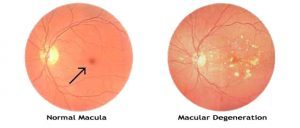
Treatment and management depend on the form and stage of the disease, but prevention and early detection are paramount.  Concisely, the dry form causes slow atrophy and scarring due to cellular debri accumulation, called drusen, and is divided into three progressive stages.  Duly noted, is a link to Alzheimers disease, due to the similarity of the drusen accumulation.  Retinal imaging is being explored as a future indicator of this disease.  Genetic testing of specific markers are strong predictors of risk/progression of these age related diseases, but can be an expensive option.  The goal is to promote prevention and reduce progression through lifestyle changes and supplementation of carotenoids, such as lutein and zeaxanthin with omega-3s.  Studies have shown that a combination of these supplements reduce the risk of progression(see AREDS 2 study). Cessation of smoking is imperative. UltraViolet Radiation protection when outdoors and protection from extended exposure to high-energy visible light emitted from digital devices, known as Blue Light, is also crucial. The wet form of macular degeneration is less common(10-20%), but has a rapid onset.  It usually preceded by the dry form, but not always.  It is caused by abnormal blood vessel growth that leak and require treatment immediately upon diagnosis, with early detection leading to more favorable outcomes.  The mainstay of treatment for wet AMD is monthly ocular injections to reduce leakage and prevent further blood vessel growth.  Although this procedure may seem extraordinarily undesirable, it is relatively painless and preserves sight for this aging demographic that would otherwise have lost their independence.  Previous treatments include lasers that scar the macula resulting in permanent vision loss, but halted new blood vessel growth.  

Several new treatment options are being explored for this disease.  The optimistic results of a topical maintenance drop daily instead of monthly injections are on the horizon.  Promising stem cell research results will dramatically change the future treatment.  Reducing risk factors is the paramount in those genetically predisposed.  At Envision Eyecare, we evaluate an indicator of risk on every patient over 40(or family risk of AMD and Diabetics), known as the Macular Pigment Optical Density(MPOD).  With dietary changes and/or supplementation, we have documented significant improvements in pigment density, which study indicate shield the macula from deleterious effects of high-energy blue light.  Being proactive can function as a barrier to those at risk.  Our team at Envision Eyecare is passionate about enhancing, protecting, and preserving our patients vision.  We provide education on technology that completely filters the blue light to protect the macula, also promoting less fatigue on digital devices and enhancing deep sleep patterns.  In later stages of AMD, low vision therapy specifically designed for patient needs, including devices such as magnifiers, specular telescopes, computer applications and closed-circuit TVs, can also be helpful in maintaining independence.

In the next edition, I will explore the holistic approach to ocular health and vision correction with an open mind, addressing the insightful benefits and gross misconceptions that concern me from an evidence based prospective.  Balance is essential. Knowledge is awareness.  Stay connected.  Protect your eyes and enjoy your sight!

All the best,

Dr. B
[/av_textblock]

[av_one_full first min_height=” vertical_alignment=” space=” custom_margin=” margin=’0px’ padding=’0px’ border=” border_color=” radius=’0px’ background_color=” src=” background_position=’top left’ background_repeat=’no-repeat’ animation=” mobile_display=”][/av_one_full]

[av_one_half first min_height=” vertical_alignment=” space=” custom_margin=” margin=’0px’ padding=’0px’ border=” border_color=” radius=’0px’ background_color=” src=” background_position=’top left’ background_repeat=’no-repeat’ animation=” mobile_display=”][/av_one_half]

[av_one_full first min_height=” vertical_alignment=” space=” custom_margin=” margin=’0px’ padding=’0px’ border=” border_color=” radius=’0px’ background_color=” src=” background_position=’top left’ background_repeat=’no-repeat’ animation=” mobile_display=”][/av_one_full]

Sun Safety for Your Eyes and Skin

Don’t get burned! July is National UV Safety Month and we’re here to educate you on sun safety! According to the American Academy of Dermatology, it’s estimated that 1 in 5 Americans will develop skin cancer in their lifetime. Harmful rays from the sun can also cause sunburn, damage to your eyesight, the appearance of aging, and other changes in your appearance. You can easily protect yourself and your family from the sun.

The simplest way to protect your skin is to wear protective clothing, a hat and broad-spectrum water-resistant sunscreen on any exposed skin. Broad-spectrum means it protects against both UVA and UVB rays. The sunscreen should have a Sun Protection Factor (SPF) of at least 30 and should be applied liberally. The rules for applying sunscreen is basically apply some and then apply some more because the AAD says most people only apply 25-50% of the recommended amount of sunscreen. That reduces the sun protection! Apply a generous amount 15 minutes before you go outdoors. It should be reapplied about every 2 hours and/or after swimming or sweating. Don’t forget lip protectant with SPF. Sunburn is not fun; remember that it increases your chances of skin cancer.

The best way to protect your eyes and the skin around them is also a hat and high-quality UV-resistant sunglasses. Sunglasses should cover and protect you from all angles. They should block 99-100% of UV rays and absorb most HEV rays. Babies and children need to be properly clothed and outfitted with sunglasses and hats. Who would want to miss an opportunity to dress your little one in cute sunnies and hats anyway?! We can help you pick out the best sunglasses to protect yourself and your loved ones.

Shade is nice, so why not try it out! Sitting in the shade can block rays. Sources say the sun is at its strongest between 10 am and 2 pm. That sounds like the perfect time to enjoy a shady spot! Keep in mind, just because it’s cloudy doesn’t mean you can skip the sunscreen! Up to 80% of the sun’s harmful UV rays can still penetrate your skin on cloudy days. Just because it’s winter doesn’t mean the sun isn’t a danger either. You should wear your sunglasses in the shade, on cloudy days, and all seasons. Other risks for sun exposure are higher altitudes and reflective surfaces such as water, sand or snow.

To read more about sun safety or determine your risk levels, you can check the Environmental Protection Agency’s UV index daily.

Free Eye Exam for Infants at Envision Eyecare

Envision Eyecare participates in a wonderful program called InfantSEE, a public health program that allows us to provide a comprehensive eye assessment to children between the ages of 6 and 12 months as a no-cost public service. This program is managed by Optometry Cares of the American Optometric Association Foundation. According to Optometry Cares, the program is “designed to ensure that eye and vision care becomes an essential part of infant wellness care to improve a child’s quality of life.”

It is extremely important to schedule an early eye exam for your baby’s health and development. Your child’s eyes are developing, his or her eyes and brain are learning to see, all of which is helping your child to learn and develop. Proper or improper eye development is not necessarily something that can be recognized by a parent. Your baby’s vision is huge in developing coordination and motor skills, recognition, stimulation, and so much more at such an early age. Learn more about how an infant learns to see and the steps of eye development. An optometrist can also help you determine how to visually stimulate your child and help his or her vision develop properly. According to the AOA, by two years of age, a child’s eye-hand coordination and depth perception should be well developed.

The other unfortunate fact is that many eye conditions have no symptoms that can be identified by a parent or even a routine check-up by a family physician. A more detailed exam by an optometrist can in fact catch these eye conditions that can be treated or corrected early on in your child’s life. With some conditions, your child’s vision can be corrected, in the worst case scenarios it can be saved. The hard facts according to the AOA are that of the 3 to 4 million babies born every year in the United State, 1 in 20,000 has retinoblastoma (eye cancer), 1 in 25 will develop strabismus (commonly known as crossed eyes), and 1 in 30 will develop amblyopia (or lazy eye).

At your infant’s first eye exam Envision Eyecare will test for excessive or unequal amounts of nearsightedness, farsightedness, or astigmatism. We will test for eye movement ability and eye health problems. These tests will not be invasive for your child. Don’t worry; our Envision Team is experienced with children of all ages. Helping ensure your child’s development and quality of life brings us great joy!

Schedule your infant’s comprehensive eye exam with us, compliments of InfantSEE!

Envision Eyecare Medical Assistant Receives Certification

We are happy to share that our very own Vickie Carpenter, Medical Assistant at Envision Eyecare, was recently certified as a Certified Paraoptometric (CPO).

A CPO(TM) is a person who has attained national recognition via certification by demonstrating an understanding of the concepts used in optometric care. Vickie studied hard for several months and passed the examination with flying colors on Friday, November 20th. We congratulate Vickie on her accomplishment, and we hope you will too on your next visit here! 

Vickie had to answer questions related to basic science, clinical principles and procedures, ophthalmic optics and dispensing, and professional issues. Here’s a more detailed breakdown of the knowledge she has proven that she has after receiving this certification: 

CPO Examination Content

Basic Science Anatomy, common eye disorders, terminology, surgery, and basic pharmacology

Clinical Principles and Procedures —Eye examination, refractive status, and contact lenses

Ophthalmic Optics and Dispensing—Ophthalmic prescriptions, ophthalmic lenses, and ophthalmic dispensing

Professional Issues — Eyecare specialists and ancillary personnel and practice management

We are very excited for Vickie and we are certainly proud to have her as part of our Envision Eyecare team!

The graphics and information are courtesy of the American Optometric Association. Learn more about the certification here.

How To Prevent Eye Infections

As it is with pesky infections, many types of eye infections can easily be spread from person to person. To protect yourself and your loved ones this winter, be sure to follow these tips. First of all, we cannot stress how important it is to thoroughly wash your hands! Wash your hands before touch your eyes or eyelids and especially before handling contact lenses. This is something that should be stressed to children so that it becomes habit for them.

If you are near a person that has a red eye, it can be a warning sign and you should avoid contact with your face and eyes until you wash your hands first. You can minimize the likelihood of catching common bacterial or viral eye infections by using anti-infective sprays and cleaners liberally in public areas or areas that may have been infected. Better safe than sorry! If any family members have a red eye or have a diagnosed infection, clean their bedding, pillows, and towels daily. Do not share linens with someone who has an infection. It is a good idea to wash the infected person’s linens after each time they use them. Be sure that your family members are washing their hands often.

You should definitely avoid wearing contact lenses and eye makeup if you are infected. Be sure to avoid sharing makeup or makeup tools with a potentially infected person. Another tip is to avoid sleeping in contact lenses, even if they are breathable FDA-approved type for overnight wear. Unfortunately, sleeping in your contacts significantly increases the risk of eye infections.

We’ll say it again: don’t forget to wash your hands often!

Read more about preventing eye infections and types of infections at the American Optometric Association.

Children And Their Eyes…


Before I became a part of the amazing team at Envision, I worked in childcare.  I got my degree in psychology with an emphasis in child development.  I was a preschool teacher for three years, baby sat everyone’s kids when I could, and was a nanny to three children for almost two years.  It’s safe to say, I know a thing or two when it comes to kids.

Throughout my years of working in childcare; kids would get sick, pink eye would be passed around, and there was always your occasional lice check.  I always heard parents talking about taking their children to their primary care physician for check up’s, or to the dentist to get their teeth cleaned, but never did I hear anyone talk about taking their child to the eye doctor.

Since working in the eye care field, I have learned so much about the importance of a yearly, comprehensive eye evaluation.  Most individuals assume that you don’t need to go to the eye doctor unless you are having trouble with your vision.  Truth be told, having the actual health of the eye evaluated, is very important for individuals at any age.

Did you know that children can suffer from congenital glaucoma or retinoblastoma, a rare malignant tumor of the retina?  These types of diseases and other conditions can all be spotted with early detection, and often times, corrected if caught soon enough.  This is just one reason to have your child evaluated at an early age.

The American Optometry Association estimates that 1 in 4 children have a vision- related condition, and 60% of learning disabilities are associated with vision problems.  Poor vision can also affect a child’s physical and neurological development as eye muscle imbalances called strabismus or more commonly, “crossed eye’s” can lead to amblyopia, also known as, “lazy eye.” This is when the individuals brain suppresses vision from one eye to avoid seeing double, which can lead to total vision loss in that eye if untreated.

Getting your child into the eye doctor between 6-12 months is the perfect age for an initial comprehensive screening.  InfantSee, a public health program for infants, offers a free comprehensive evaluation to infants before a year of age.  This is a great way to get your child screened early to be sure their eyes are healthy.  After the initial screening children can return to see their eye doctor around Kindergarten for a vision assessment and eye health evaluation.

If you are interested in getting your child seen for a comprehensive exam, or if you have questions about your child’s eyes, or vision, please come by or call our office.  We would love to help in any way we can.

By: Katie Porter